

When I got introduced to crypto one of the smartest guys I met told me “buying forced selling/liquidations is nearly always free money.” Noted, followed, made some money buying the blood when it appeared. Happened quite often – a few times a year (1b+ perp liquidations/day). Crypto traders kinda got used to sharp sell-offs between 30% and 60% on altcoins, still it was broadly expected that every coin will see its bounce sooner or later. This mentality drove the markets and led to in hindsight extreme low and high valuations.
Fast forward to 2026, since 10/10 we had ~10 days with reported liquidations above $900 million. I can’t remember any one of them in a way where everyone was eager to get the best long or spot entries. The dreaming is gone and the tourists are also gone. In the following article, we are finding a few reasons why blindly buying liquidations is -EV in crypto nowadays.
Market participants changed, from people that were looking for their lottery ticket out of 9 to 5’s to mostly VC pre-seed rounds and institutional backings that are mainly looking for ways to exit early markets in the most efficient way. On-Chain doesn’t give you access anymore to the lowest market caps in a growing sector and this is a major reason for retail absence. TL;DR: The crowd got well more informed + the psychological thinking behind a position changed by 180 degrees (from “let me buy ahead of others” to “how can I get off board ahead of others holding this overvalued asset”)
Shift in Flow
The mechanics behind liquidation bounces were simple: perp-heavy market, overleveraged longs get flushed, shorts pile in, price snaps back when shorts cover. For years this was a reliable loop. The problem: perps are no longer the dominant driver of flow. Outside of weekends, where spot liquidity thins out and perps still move price, most of the selling pressure today comes from spot. Strategic spot sellers. VCs unlocking. Funds rebalancing. ETF outflows. These sellers don’t get liquidated. They choose to sell. Also, when the selling is spot, there is no mechanical bounce. The supply just hits the book and sits there until someone wants it. Often nobody does. Prime example: Celestia, Ticker $TIA that went from >$20B valuation to $300M market cap without any prolonged and lasting rally.
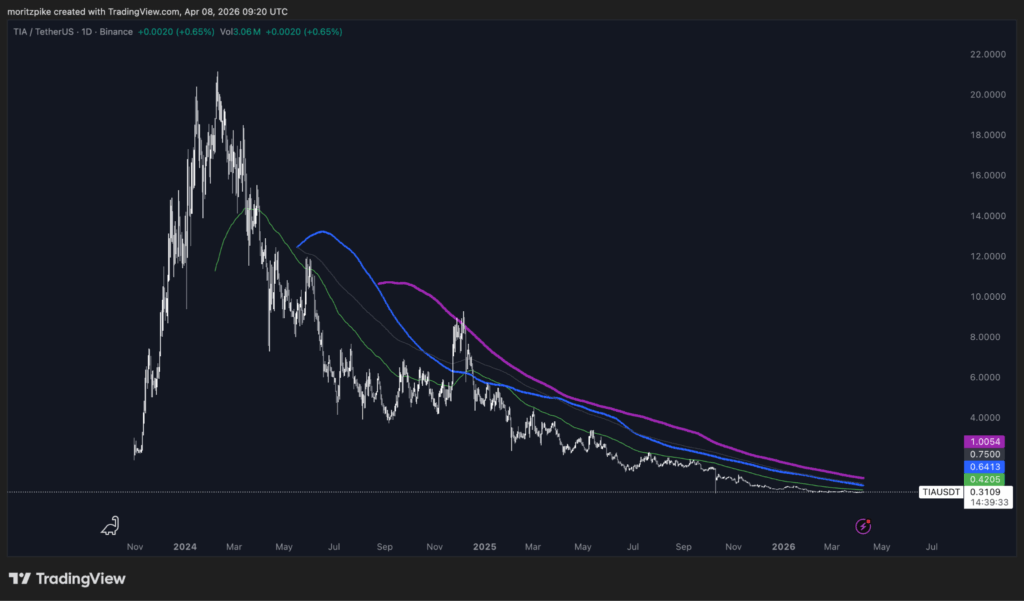
Which leads to the real question you should be asking before any dip buy: who comes in after me? In 2021 the answer was easy. Degens re-leveraging, retail FOMO, funding rate flips attracting carry traders. Today on most large caps, the answer is silence. No new narrative to pull capital in, rarely crowded shorts to squeeze, no wave of fresh wallets rotating in (besides fake team wallets lmao). You’re not buying a coiled spring. You’re catching a falling rock and hoping someone taps you on the shoulder to take it off your hands.

There are exceptions. One of them is probably to signal wrong or mispriced “FUD”. Spoiler: happens really rarely, but it does happen from time to time. Prime example: $HYPE when Continue Capital and a Tornado Cash funded wallet sold high 9 figures of the coin into illiquid books on sundays, end of January, $HYPE / $OTHERS performed a 100%+ rally after this.
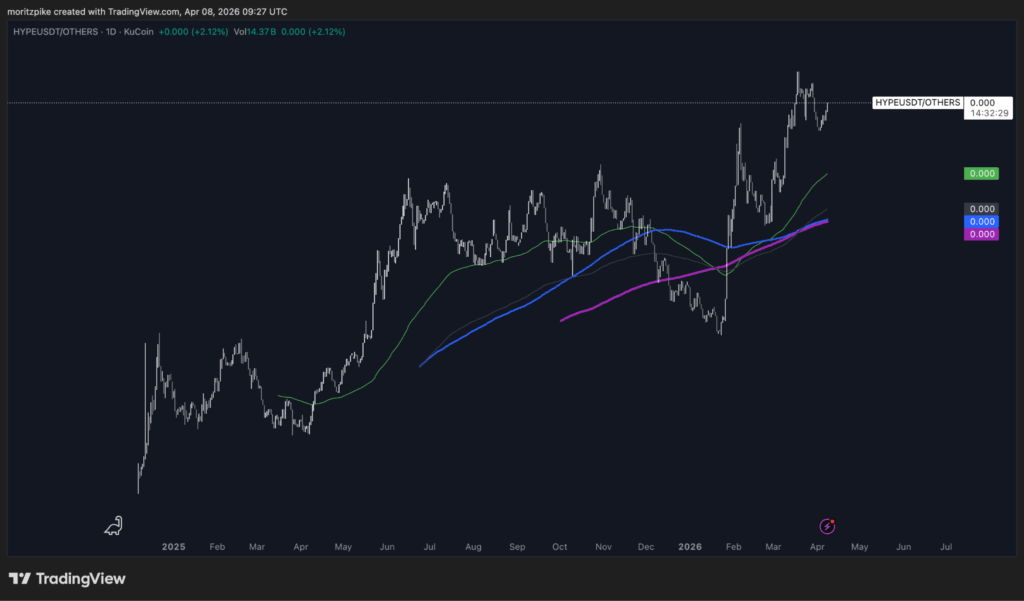
The tricky psychology of knife catching
Buying something cheaper than it was yesterday feels smart. That’s the trap. Knife catching rewards you just often enough to build real confidence in a strategy that is net negative over time. You remember the 3 times it worked, you forget the 5 times you averaged down into something that never came back.
The deeper issue is mean reversion bias. Crypto trained an entire generation of traders to believe that everything bounces. And for a while it did. But “it dropped 40% so it has to bounce” is not a strategy, it’s a reflex. And reflexes don’t ask questions like why is this dropping, who is selling, and does anyone actually want to own this at any price.
The moment you catch yourself thinking “it can’t go lower” you’ve already stopped analyzing and started coping.
Accept Relative Weakness as a Signal
Downtrends don’t just destroy value. They sort it. The coins that hold up in a selloff are telling you something. The coins that can’t attract a single bid even after a 60% drawdown are also telling you something. Most people ignore the second signal because they’re too busy calculating how cheap it got relative to the highs.
But “cheap” means nothing without demand. A coin trading at 80% below its ATH with no buying interest at any level is not a discount. It’s a market that has made up its mind. Meanwhile the coin that barely dipped while everything around it bled just showed you relative strength in real time. That’s the one worth paying attention to. The coins that hold their ground in a downtrend are the ones most likely to lead the next move up. Knife catching is a reflex. Relative strength picking is a filter. One feels smart in the moment, the other actually compounds over time (and are way easier to manage with tighter stops).
Next time you see a sea of red and your finger hovers over the buy button, ask yourself one question: who is buying after me? If you don’t have an answer, you are the answer. If there is an answer, go ahead and execute.
This article was published in cooperation with Derive Insights.
Leave a Reply