

Bitcoin implied volatility has spent the summer compressing. Volmex BVIV prints 37 against a June peak near 60, Glassnode had upside implied vol at a record low 23% on August 6, and spot has held a narrow band around $64k for weeks.
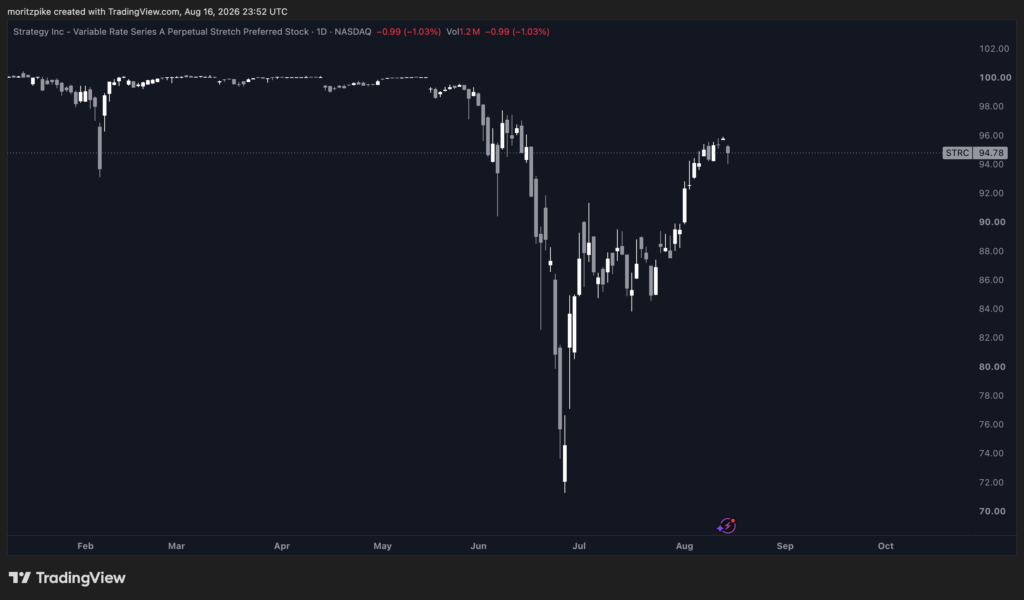
Over the same period $STRC, Strategy’s Variable Rate Series A Perpetual Stretch Preferred Stock, traded from a $71.25 low on June 26 back to $94.78 on Friday. The instrument carries a $100 stated amount and a monthly rate reset whose entire purpose is to hold the price near par and suppress volatility. It ran a 28.7% drawdown and a 33% recovery in ten weeks.
The recovery has a mechanical explanation that Strategy files every Monday.
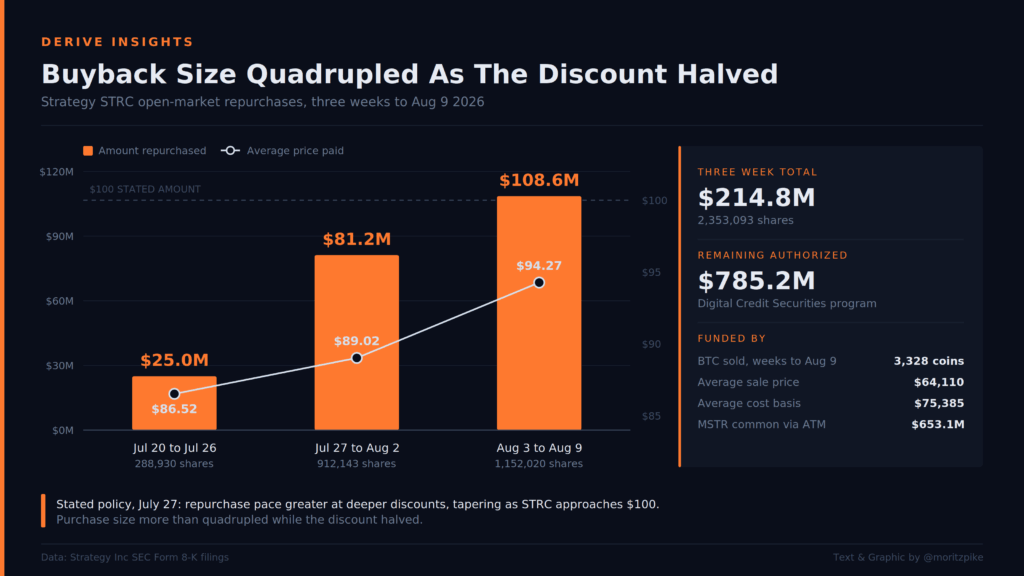
That is roughly $214.8M across three weeks, with $785.2M still authorized under the Digital Credit Securities Repurchase Program.
On July 27 Strategy said repurchase pace would generally be greater at deeper discounts and would taper as STRC approached $100. Purchase size then more than quadrupled while the discount halved. Whatever the policy language says, the company bought harder into strength than into weakness.
Funding came from the asset. Strategy sold 1,638 BTC at an average $63,957 in the week to August 2 and another 1,690 at $64,262 in the week to August 9, routing proceeds directly into STRC repurchases, against a $75,385 average cost basis on the remaining 840,447 coins. It also placed $653.1M of MSTR common through the ATM in the week to August 9, of which $650M went to the USD reserve, now at $4.65B. The preferred recovered because the common and the coins paid for it.
The natural read is that the market is betting against a Saylor liquidation.
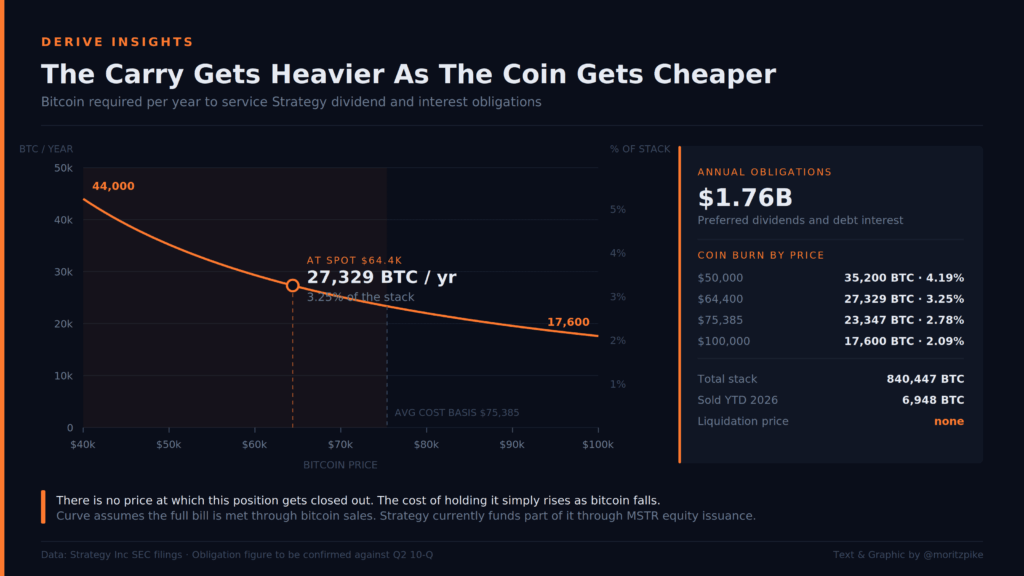
What sits there is a funding rate. Strategy is a levered long that cannot be closed out but pays permanent carry, and STRC holders are on the receiving end of it. The position does not blow up at a price, it bleeds coins at a rate.
That rate is quantifiable. Annual dividend and interest obligations sit near $1.76B, which at $64.4k works out to roughly 27,300 coins a year, or about 3.2% of the stack, in the case where equity market access closes and the full bill falls on monetization. The variable to watch is therefore access to the ATM rather than any particular bitcoin level.
Count only the convertibles against assets and Strategy looks like something close to a 1.2x long, which is defensible given that preferred is legally equity rather than debt.
The preferred does not appear in the debt column and it is also the thing forcing coin sales. Leverage without a margin call still consumes the asset, it just does it on a schedule rather than in a single print.
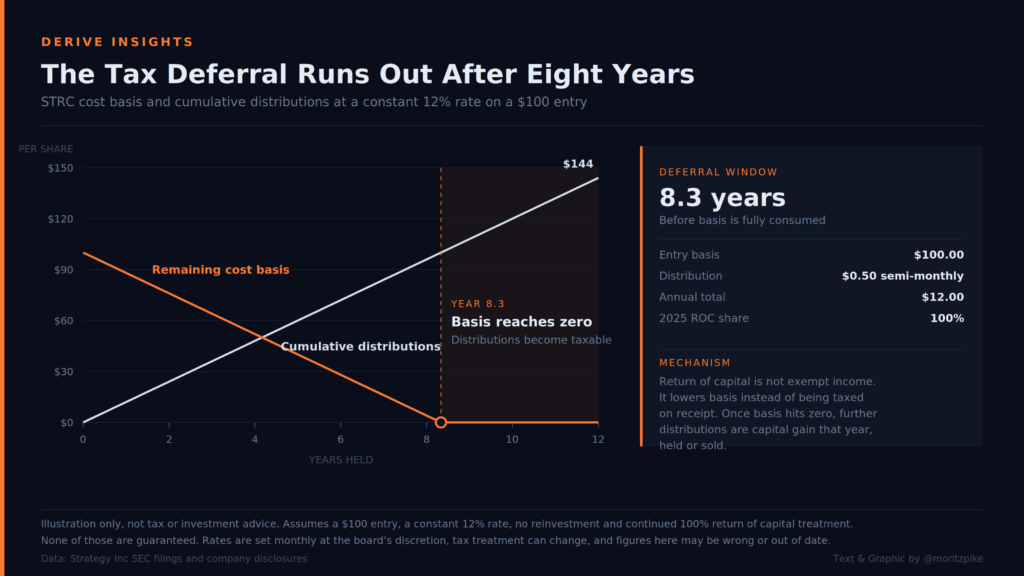
Buyers are supplying that leverage and are compensated for it. STRC pays 12% annualized, semi monthly since July, and 100% of 2025 preferred distributions were classified as nontaxable return of capital.
The deferral is real but finite. Return of capital reduces cost basis rather than exempting income, so a $100 basis at 12% is consumed in roughly eight years, after which further distributions become taxable gain in the year received whether or not the position is sold. The tax treatment works because the issuer is structurally unprofitable, which is an unusual dependency for a yield product.
Against that, JPMorgan puts the cost of each ratchet trigger at roughly $53M in additional annual obligations, with increases that do not reverse when the price recovers. A conventional preferred repricing lower raises the yield for incoming buyers and leaves issuer cost untouched, while STRC does both. That is the asymmetry Onramp’s Michael Tanguma was pointing at when he argued a capital structure surviving volatility by adding permanent obligations has a finite number of cycles in it. STRC last traded at $94.78 against a $95 threshold.
Who is actually long? Retail mostly, according to JPM estimations near 83%.
The cheapest implied volatility in the bitcoin complex is currently in bitcoin options, and the most expensive realized volatility is in the securities layered on top of it.
Produced by Derive Insights. Charts follow the Derive Insights house style. Figures are drawn from Strategy Inc SEC filings and company disclosures, with market data from Volmex and Glassnode. Analysis of publicly filed information only, not investment or tax advice.
Leave a Reply